


Fairytale Sunday, 23/06/2024
The New Orphic Youth, & Marcuse's Eros & Civilisation

Click here for previous Fairytale Sunday (it’s about Sleeping Beauty – she’ll be waking up here too later).
Please don’t be put off by the length of this one, by the way – it’s kind of in two parts, as you’ll see, and you don’t necessarily have to read the second part (it’s one of my old philosophy essays).
But – please enjoy the lovely artwork, and don’t forget to like, comment, and definitely share, if you are so minded!
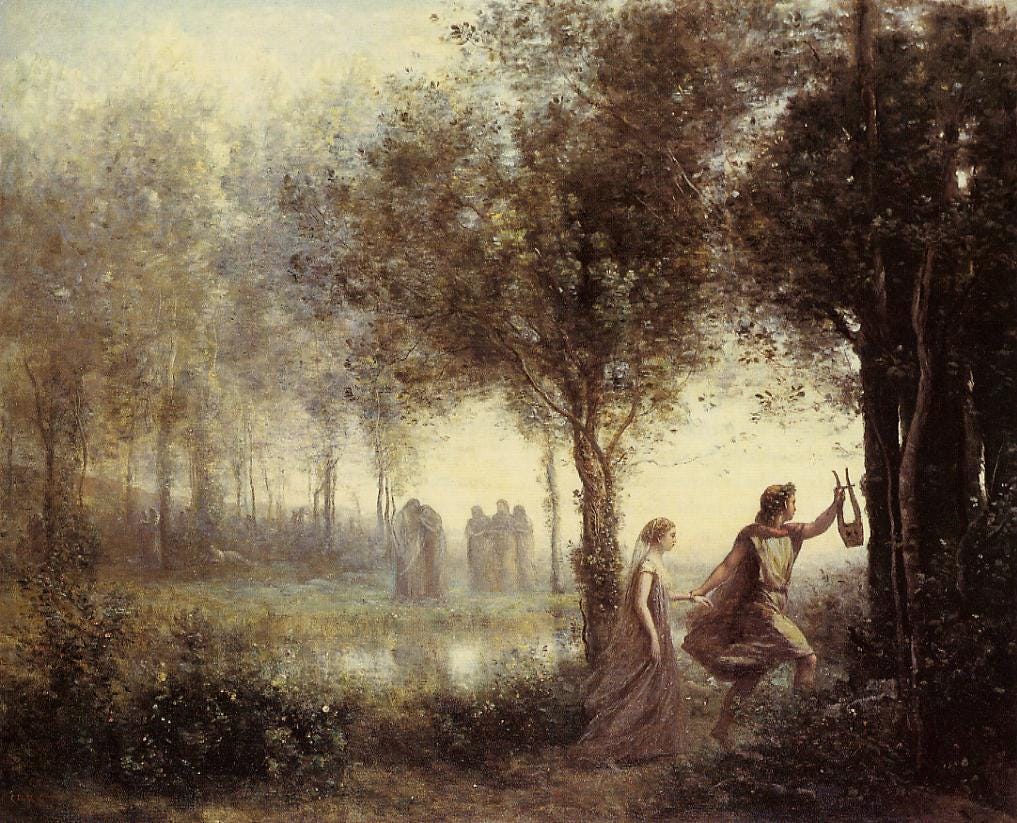
Jean-Baptiste-Camille Corot - Orpheus Leading Eurydice from the Underworld (1861)
For some whimsical reason, possibly provoked by writing this Orphic story a few weeks ago from the Lunar Awards prompt quest, I recently revisited some of my old philosophy essays from my time as an undergraduate (about 30 years’ ago – hmm, now I feel old), and I uncovered the one you will find beneath this intro, which is about Herbert Marcuse’s Eros & Civilisation (all the image-quotes are from that book, by the way - here’s a credit, with a lovely voice). I think it’s rather good, and re-reading it reawakened my self-awareness of where most of my worldview comes from. Some of you may wonder what this has to do with fairytales (in which case you shouldn’t second guess me, because that’s naughty, reader dear). I would answer it has everything to do with fairytales, for reasons which I hope shall become clear. Simply on an autobiographical level, whilst in my philosophy I was delving into the pre-Socratics, with a generous helping of Nietzsche on the side, amply complemented by a dose of the mystical or occult (my own-self-initiation into the mysteries, perhaps), over in my German studies at the same time I was joyfully lost in a forest with a little red cap (of course there’s a double meaning in there! Who do you think I am!).
The essay, then, goes to the root of my own understanding of what is wrong with the world. In fairytale terms, it’s the repression of the magical. For the ancients, after all, the magical was the real. The real world – let us call it nature – was fully infused with the spirit. The ‘ego’ of prehistoric man was fully engaged and out there. Just as today, after modernism, the fairytale has arguably been dumbed down by Disneyfication, so too has the intrinsic spirit of nature herself been repressed. For Exhibit A, I give you this lifeless and dirty name ‘Earth’ which everyone uses for a planet which, in actual fact, has an intelligence and an essence. As the Greeks called her Gaia, the Atlanteans called her Danuih.
This, I would argue, is the fundamental reason for the pandemic of mental illness which, I might also argue, threatens to extinguish humanity (or turn it into a monstrous caricature of its former self – which is perhaps worse). Without the spirit, human beings are enslaved. Historically, if we’re going to get conspiracy theory about it, one might also point out that the ‘grand conspiracy’ of ‘world domination by a minority group of monsters’ could fundamentally not succeed without such repression. Look back in history and you will readily discern the roots of this. No graven images.
Freud put it thus in Moses & Monotheism – ‘the compulsion to worship a god whom one cannot see’. Deny the ‘images’ from humanity and they are lost. Blind. This is fundamentally, by the way, why his conclusion that Moses equals Akhenaton was the opposite of the truth. Akhenaton promoted the visible sun disc, as opposed to the ‘hidden one’ Amun – and despite disingenuous modern orthodoxy, he was absolutely not a monotheist (as evidenced by self-portrayals, together with his consort Nefertiti, identifying with deities such as Shu and Tefnut; not to mention highlighting the importance of Ma’at – Dike, in the Greek), but utterly opposed to the creeping Establishment – but this is another story.
And what do we mean by ‘images’? We mean imagery; we mean allegorical symbols; we mean the right kind of stories. Fairytales, from a certain point of view, are a pagan rebellion against that repressive prohibition (and no wonder the puritans initiated witch-hunts). We are, then, touching once again on narrative theory – since, as I have said elsewhere, human beings see and understand the world through stories. Ancient ‘religions’ were rich with symbolism and mythical narratives, all of which generated a navigable harmonia with the world, with reality, with each other. The so-called monotheistic ideologies have, being a conspiracy, removed and repressed and destroyed all of that – deliberately so, in order to render blind and enslave.
The initiate, by contrast, says do eat the apple.
Now you can understand how much I like Nietzsche, eh.
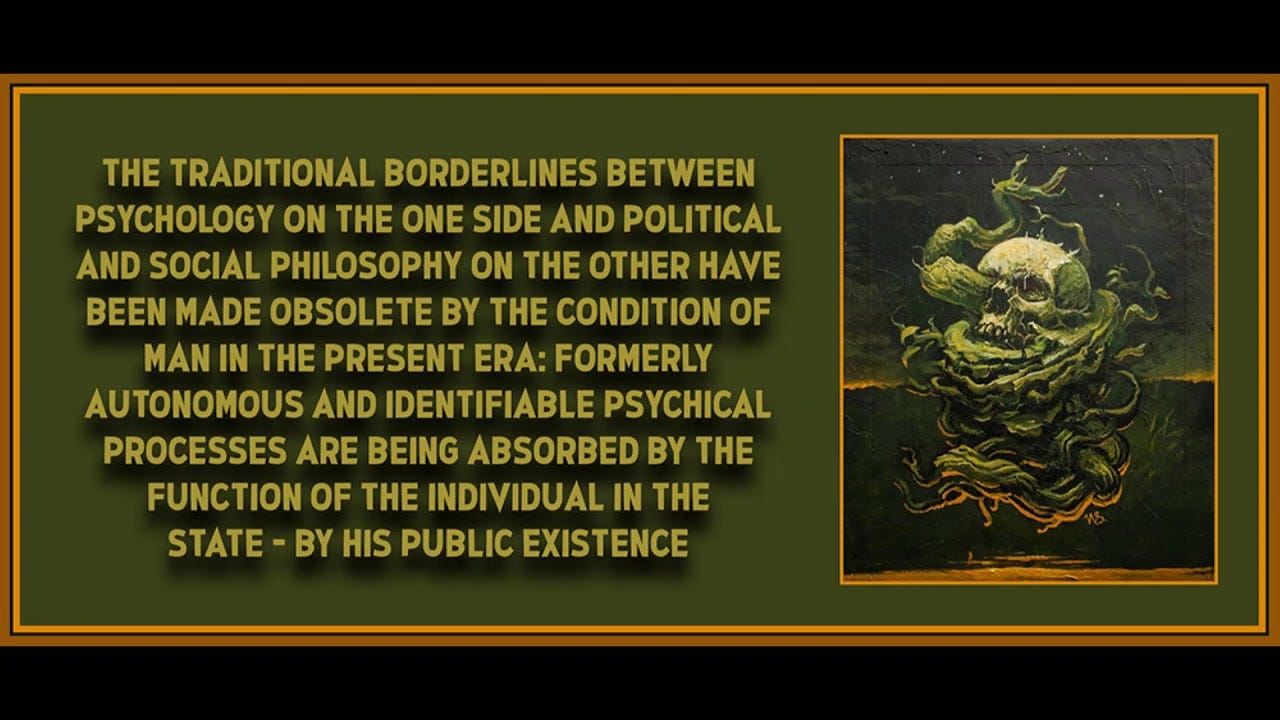
At the same time, my understanding in this comes from two other places – on the one paw, an understanding of the mysteries, on the other, an understanding of psychology.
And I would venture this;- no true liberation or ultimate revolution can proceed, let alone succeed, without this understanding. The organic revolution should and must not solely consist in some kind of anarchic dismantling of the modern world. Any genuine ‘return to nature’ must at once include a return to the mystical, the magical, the One Truth. Without that, humanity will continue to be lost in the woods. Without that, you are left only with ‘bioessentialism’. Which is an empty shell, devoid of essence.
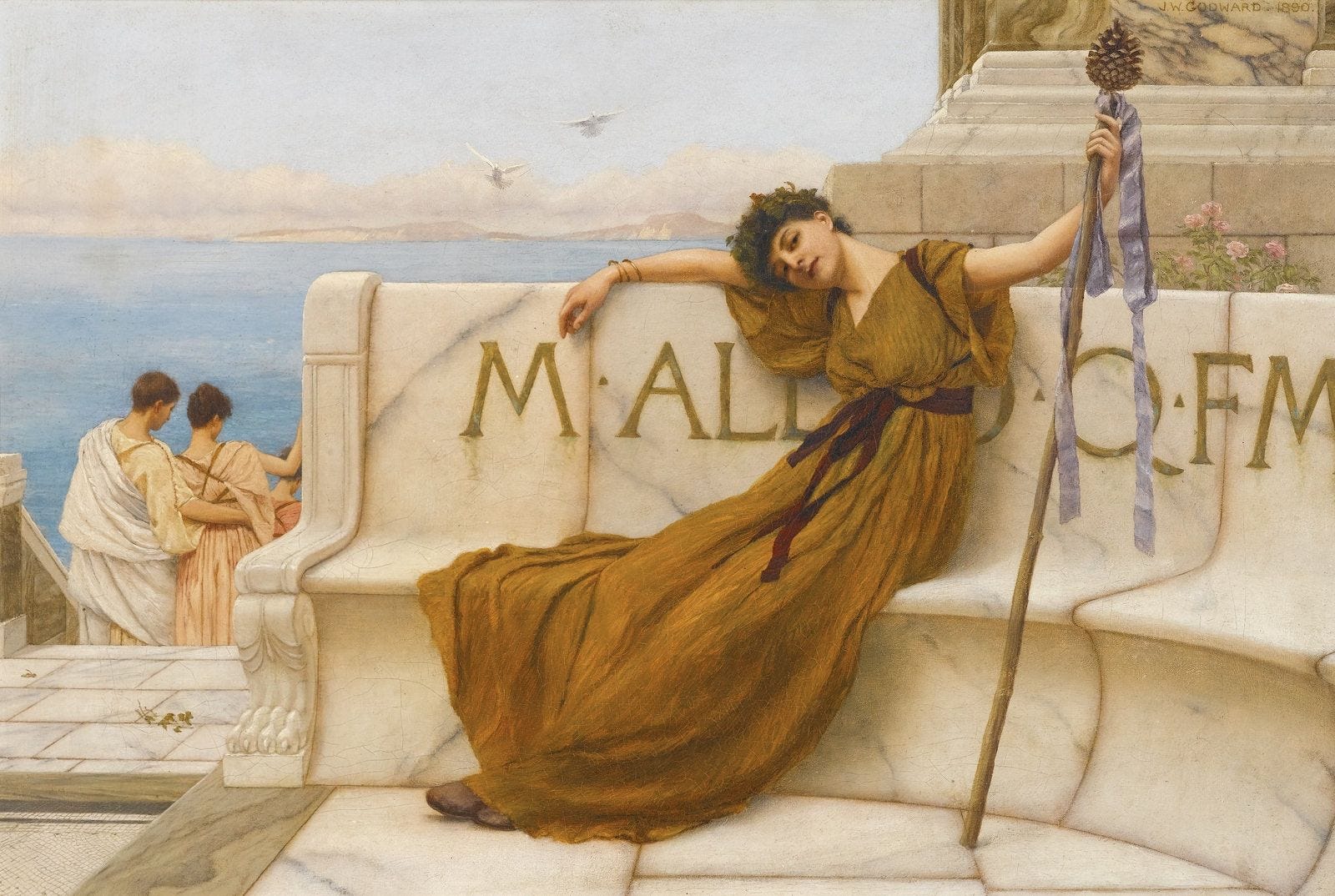
John William Godward - A Priestess of Bacchus (1890)
I’m on quite a roll here, I think. Bear with me.
There is, in my view, very little difference between ancient mythologies and fairytales. Both are designed, at least in part, to facilitate individuation. The maturity of the individual into a full and complete appreciation of the richness of the real world, to allow the child who becomes the adult to retain their innate understanding of magic, mystery, and spirit. Of course there are life-lessons, moral fables, cautionary tales and such, but if we only perceive those mundane aspects we risk losing the big picture – in terms of content both myths and fairytales are infused with the otherworldly. In the same way that life itself, reality itself, was infused with the ‘supernatural’ as a matter of course. It was real to the ancients, in other words. Just as it is real to children.
The modern, the atheistic, the monotheistic – all these fundamentally seek to exorcise these wonders from a child, from life itself. Perhaps they do so out of some projected fear, but more than likely, I will stick to my original proposition – it is the root and foundation of the Grand Conspiracy itself. A conspiracy against the very soul of humanity itself. It is anti-human and anti-spirit.
But I shall leave that hanging there.
Why have I subtitled this ‘The New Orphic Youth’? Because that’s what Katrina’s first album was titled. Her band name was Bacchae, which refers to the female followers of Dionysus, the god of wine, women and song (‘my three favourite things’; in modern parlance one might say ‘sex, drugs & rock n’ roll’ – Katrina always wondered why no one else had ever thought of that obvious name for a band). The Bacchae, it should be noted, whilst we are on the subject of the Orphics (which is what this article is all about), were the ones who tore Orpheus apart following his rejection of them (by some accounts, rejection of Dionysus in favour of Apollo). So there’s a taste of Katrina’s postmodern mischief there.
But she had a deeper purpose, of course. Simply by employing those two names and becoming popular and successful she aroused the curiosity in the modern youth to simply ask ‘what does Bacchae mean’ and ‘what’s Orphic’ - thus leading themselves to learn about all this, to study it for themselves, and in turn to rediscover the mysteries and overcoming the repression of modernity. A revolutionary liberation, in other words.
Notice how this is entirely lacking in modern pop or youth culture (let alone the ‘education’ system). Instead the youth are served an incessant diet of insipid manufactured vacuous clones twerking about the stage to AI-generated rubbish. That’s not even art, let alone inspiration. One might call it degenerate, even. That, too, is a deliberate conspiracy. One might add it has been thus since the birth of popular culture in the mid-fifties, when the ‘commercial’ corporations would voraciously gobble up and dumb down any new youthful musical innovation, thus provoking a cycle of new reactionary waves. Not so much the case now they’ve captured the entire industry with streaming and algorithms and suchlike. There can’t be that many young people nowadays with a great record and a sense of stylus. Likewise the conspiracy theory about all these innovative musicians being some kind of ‘controlled opposition’. Laurel Canyon and all that jazz, you know. If you think they were part of a conspiracy, their counter-culture revolutionary thought will be discredited in your mind.
But I digress.
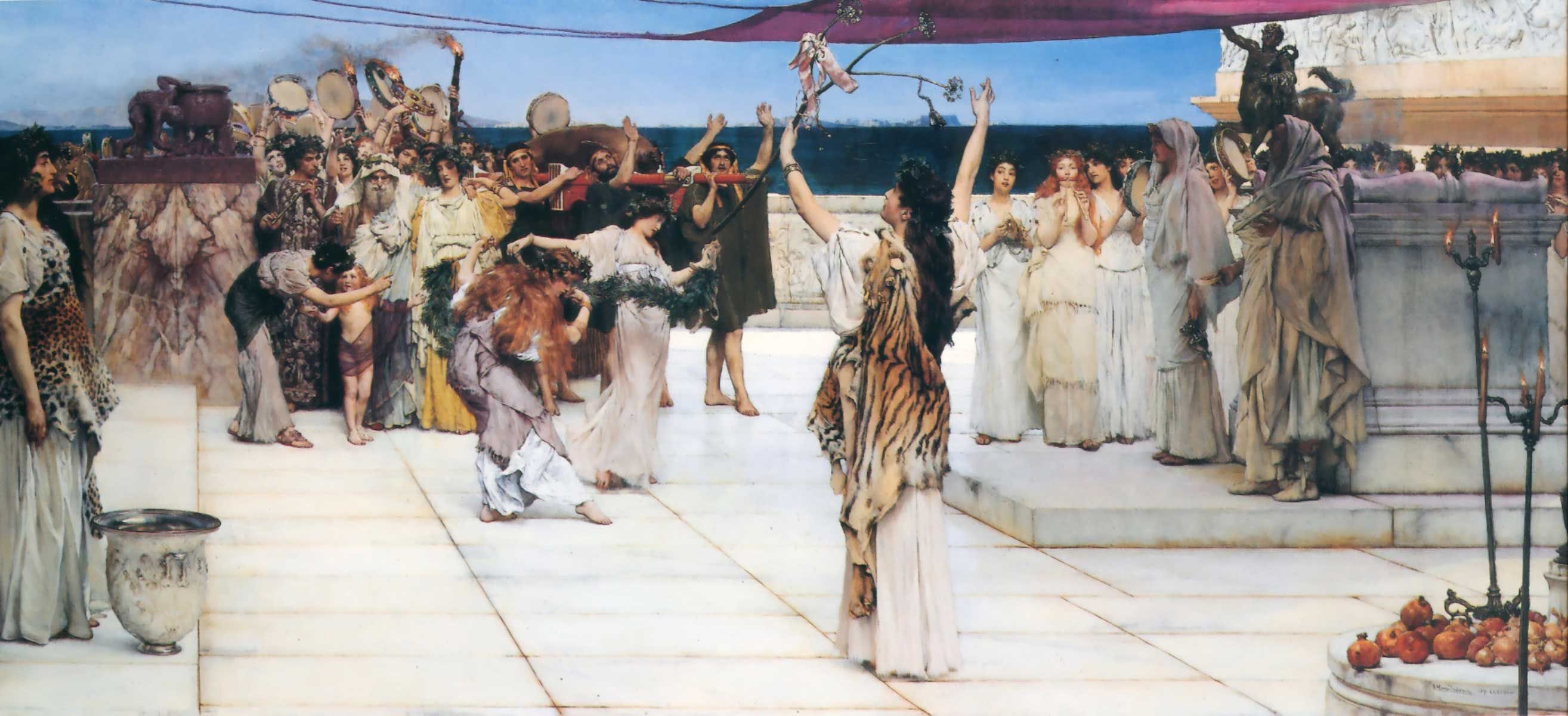
Sir Lawrence Alma-Tadera - A Dedication to Bacchus (1889)
The Orphic mysteries have much to offer for the young initiate. Simply study the symbolism of the stories. For those interested in fantasy writing there is, likewise, a Hades of a lot of material there. Ask the likes of Neil Gaiman – he’d understand. Indeed, I believe Orpheus himself did show up in the Sandman at one stage. It’s been a while, so correct me if I’m wrong there.
No, I’m right. Thought so. The similarity with ancient storytelling, of course, being the personification of archetypes. Characters which resonate with a reader.
Likewise for the youthful student of the occult, or psychology, even (the study of the psyche), one will find these ancient stories replete with archetypes. The Tarot, for example (along with its complement, astrology), can be seen simply as a lexicon of archetypes, with astrology highlighting personality traits. Numerology, then, would perhaps further complement these with an understanding of chronological progression, of an evolutionary path or journey. Those are the three I would advise the neophyte to start with. The life story of Orpheus can be viewed in the same way, as perhaps starting with the archetypal young ‘fool’ of the Tarot, who will then later journey into the Underworld (the unconscious, or deeper spirit) to recover knowledge of his ‘anima’ (to use the Jungian term). He then ‘leads it out’ (i.e. ‘educates’) back into the ‘real’ world of the living/awake (similar kinds of progress are found in fairytales, of course – the main character maturing). It is likely, in my view, that the story, or at least one version of the story, disseminated and discussed/contemplated amongst the initiates (Orpheotelestai), involved a successful outcome to the Orpheus & Eurydike narrative. Likewise there is an element of reincarnation here, along with one of the aspects that appealed to me the most, namely the advice to the initiate to refuse a drink from Lethe (the river of forgetfulness), instead choosing to drink a large draught from Mnemosyne (the river of memory), thus enabling past life memories and thus a more enlightened and self-aware spiritual evolution.
It's all there, in other words.
There’s a further archetype in the similarity with the Sleeping Beauty fairytale. By virtue of an enchantment, the female (anima) falls asleep/dies. The male (animus) must then go on a quest/journey to wake her up and lead her out again (see also the medieval romances, and Sir Orfeo – which has a happy ending, by the way). These are archetypes of maturation. The modern world is ignorant of the symbolism, of course. Both Eurydike and Sleeping Beauty fall under the enchantment because of a piercing of the skin. In the former’s case it is a snake – symbol of wisdom in the ancient world. In the latter, it is the needle from a spinning wheel. The Fates, of course, being personified as spinsters, weaving a rich tapestry and such.
In a similar sense, the journey of Orpheus into the Underworld is a representation of the ‘hero’s journey’, just as it mirrors the shaman’s.
There are likewise parallels with the Egyptian Osiris. Just as Orpheus is torn apart, so is Osiris (Dionysus too, for that matter). The head of Orpheus is then recovered by a nymph and taken to Lesbos. Osiris, meanwhile, is also rescued by a female (Isis) and with the help of magic, resurrected. We thus see narrative representations of the life cycle, both of an individual and the seasons. Just as fairytales themselves are essentially nature stories. We are looking at a sun, amongst other things.
Whilst the mysteries themselves may not have survived the repressions of Judaeo-Christianity (at least not without trauma), the narratives did. In orthodox – meaning public – Greek religion, it was something of a heresy for a human to identify with a god (for the initiate, however, identification was a purpose). Perhaps leading to the Heraclitean psychological insight, ‘the soul of a man does and does not wish to become Zeus’ (Fragment 32, I believe). Just as Judaeo-Christianity not only describes, but advocates a separation of man and the divine. Despite Jesus saying ‘the kingdom of God is within’ – meaning ‘look from God, not at God’. Jesus, it should be recalled, spent his formative years in Egypt – almost certainly studying the mysteries. Before, one might add from the imagined Gospel of Mary, foolishly deciding to go back home and liberate the people from whence he came – with a predictable result. But what is a mother to do, but accompany her foolish son?
So those archetypes did, indeed, survive the repression of ‘Christianity’ to find expression in fairytales and folk tales. Perhaps that shows the vigour and determination of the human spirit. Who knows.
But this is why we need to preserve these tales and, I would further venture, have them prominently in a national curriculum, if not in popular culture. And for those minded to be speculative fiction writers, whether of fantasy or science fiction, we would do well to bear in mind these archetypes – they are so embedded into the human psyche from aeons of evolution in a world fundamentally infused with the supernatural, with magic, that you only need to mention them to awaken that innate memory in a reader (what Jung termed the collective unconscious). But they should certainly be preserved for and disseminated amongst the youth.
Likewise, this new Orphic understanding of Fairytales, beyond this modernist analysis, whether Freudian or pseudo-feminist, is a liberating force.
I would also speculate, if I may, that seeing as the One Truth is universal, its expression only differing according to culture, that any intelligent extraterrestrials you may encounter would have recognisable mythologies. Communication, therefore, will be a lot easier than you may have thought.
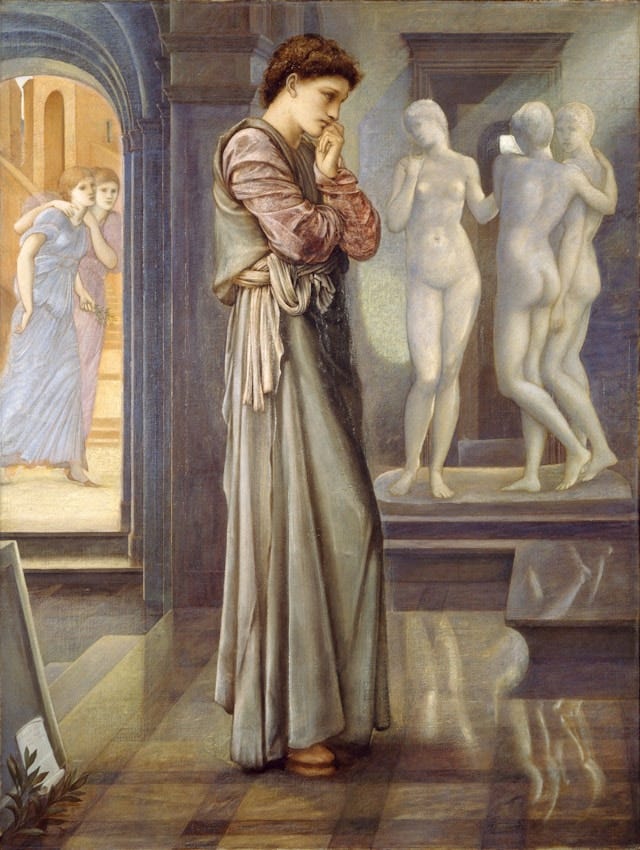
Edward Burne-Jones - The Heart Desires, 2nd series, Pygmalion (1875-78)
I will endeavour to cease rambling now. That’s already a lot to take in. I will now present you with my thirty-year old essay. Like I say, this was from a time when I was getting totally enthused by ancient philosophy and, having studied the occult first, it all made perfect sense to me. At that time the general consensus of academic philosophy was that we didn’t really know much about what the pre-Socratics thought, especially the Pythagoreans (plus it was dismissed as ‘not philosophy, but mysticism and superstition’ – which is the kind of ‘temporal racism’ you often find in modernity). Read any textbook from the time and you will only find fragments. I strongly disagreed with all that and subsequently set out to prove them wrong by writing my dissertation presenting a full and complete picture of Pythagorean philosophy. The Pythagoreans, I should point out, were intimately related to the Orphics. My principle insight was that if you don’t understand the occult, or the mysteries, or you are simply a modern materialist (let alone an analytical philosopher), of course you won’t understand a damn thing about ancient philosophy. And likewise psychology.
But first came this essay.
This one is predominantly psychological, concentrating as I did, for once in my student life, on the actual essay question. That question starts with a quote from Herbert Marcuse’s book ‘Eros and Civilisation’, which is, if I recall correctly (I no longer have it, unfortunately), a laudably vociferous attack on Freud. Given I always hated Freud, this obviously appealed greatly to me. Where Freud essentially said ‘if you have a mental illness caused by society then you’re the problem, not society’, thus internalising and reinforcing the problem, Marcuse recognises that society is the cause (thus, society must be changed, not the individual). The modern equivalent would perhaps be something like ‘cognitive behaviour therapy’, which essentially attempts to make the patient ‘well-adjusted to a sick society’ – in other words, it, like Freud, ignores the very cause of mental illness, which is a fundamentally unnatural social environment (and devoid of mystery and magic – the ‘enlightenment’ thinkers rejected monotheism but replaced it with its complement, atheism – they rejected all magic and supernature, thus soul-destroying). This is also why I say an understanding of all this, and on this level, is a necessity for anarchists and revolutionaries.
Marcuse, in the section I looked at, is talking about the Orphic concept of Eros (love, obviously, but personified as a ‘daemon’ – i.e. a bridge between the two worlds), and Narcissus. Today, of course, the word ‘narcissus’ and its offshoots (or discontents, perhaps) has been imbued with negative connotations. For the more puritan of the ancients, that may also have been the case. For one such as Nietzsche, however, or the initiate, even, one would say that ‘self-love’ is surely a prerequisite for enlightenment and the love of others. It is a positive attribute, in other words. In the Orphic sense, it can simply mean ‘self-reflection’, or self-understanding. When we meditate on these stories, after all, we discover. These stories all have some point.
Contrast this with, say, Pygmalion, who spurns women and falls in love with his own creation. He silently wishes for a bride who could be as perfect as his statue, a wish that is ironically granted by Aphrodite (perhaps to mischievously teach him a lesson). This, to me, seems somewhat more narcissistic than Narcissus. And yet the Goddess rewarded him.
That would never happen today, eh.
Anyway, as I say, I like this essay. If it has its faults, then the one I would highlight, aside from stylistic considerations (I’ve not edited them, by the way, so you don’t have to feel too bad about your own juvenilia), is that it kind of assumes the reader knows as much as I did at the time about the subject. I was, after all, supposed to be writing it for a professor of philosophy who you would expect would, indeed, know at least as much as I did. Clearly, however, not, as if I recall I only got 50-something for it! Likewise when I wrote my dissertation on the Pythagoreans it must’ve been clear I knew way more than that professor. So, perhaps professional pride (or narcissism?) prevented that prof from awarding the student their just rewards. I think I got 60-something for that one. So in the end I came away with a Desmond. Not bad, though, seeing as it was only in this, my final year, that I actually bothered to do some work. Coming out of my own Underworld, which had a lot to do with something called ‘amphetamines’, also helped.
I very much doubt the rich experiences I had at university would likely be able to be had by today’s repressed youth.
Which is a tragedy.
Well, there’s my long intro. I should say at this stage that this essay runs in at around 3,700 words, and like I also mentioned the flaw is that it assumes the reader is fully versed in the subject matter. If this is not you, then remember you really don’t have to read it! I’m hoping in that case I’ve already given you a fair amount of thoughtforms to play with in your own time.
For those who do wish to read the essay, but do require familiarity with the subject (namely the Orphics, plus a sprinkling of Plato perhaps), then I found two excellent summaries of Orphism/the Orpheus myth, which you can find here, and here (they both have a ‘reject all’ button for the cookies, by the way – I checked). Both of these sites also contain some wonderful paintings from the history of art inspired by the Classics. As some of you may know, I have recently rekindled another love of mine, namely the pre-Raphaelites, and there’s a fair amount of that there.
But I will not hold anything against you if you wish to leave things here, and decline to read the essay (or perhaps leave it for another time). I append it anyway, though, so at the very least, it’s out there, as it were.
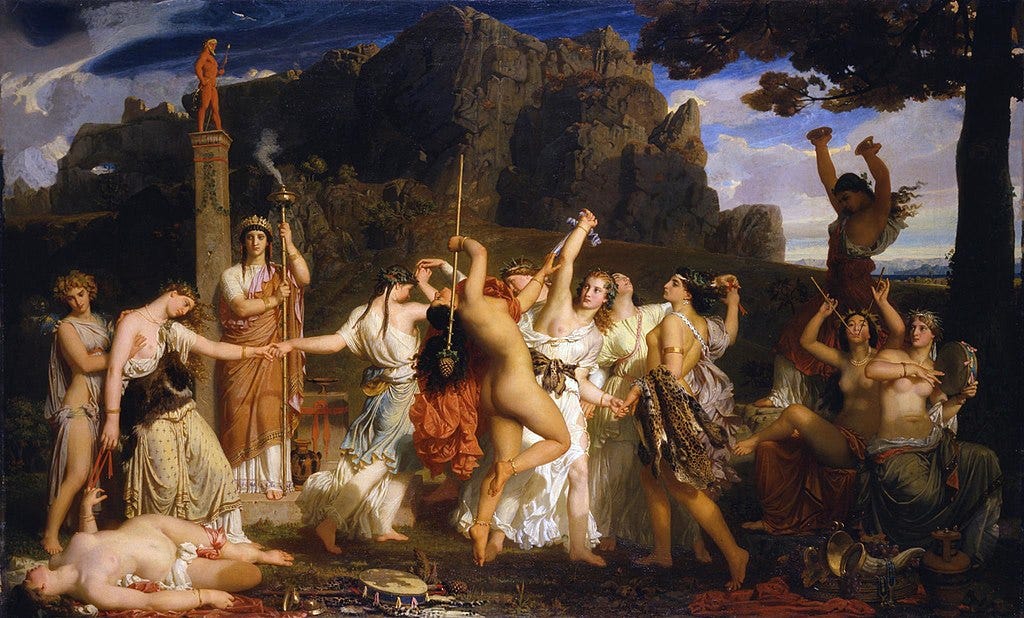
The Dance of the Bacchantes - Charles Gleyre (1849)
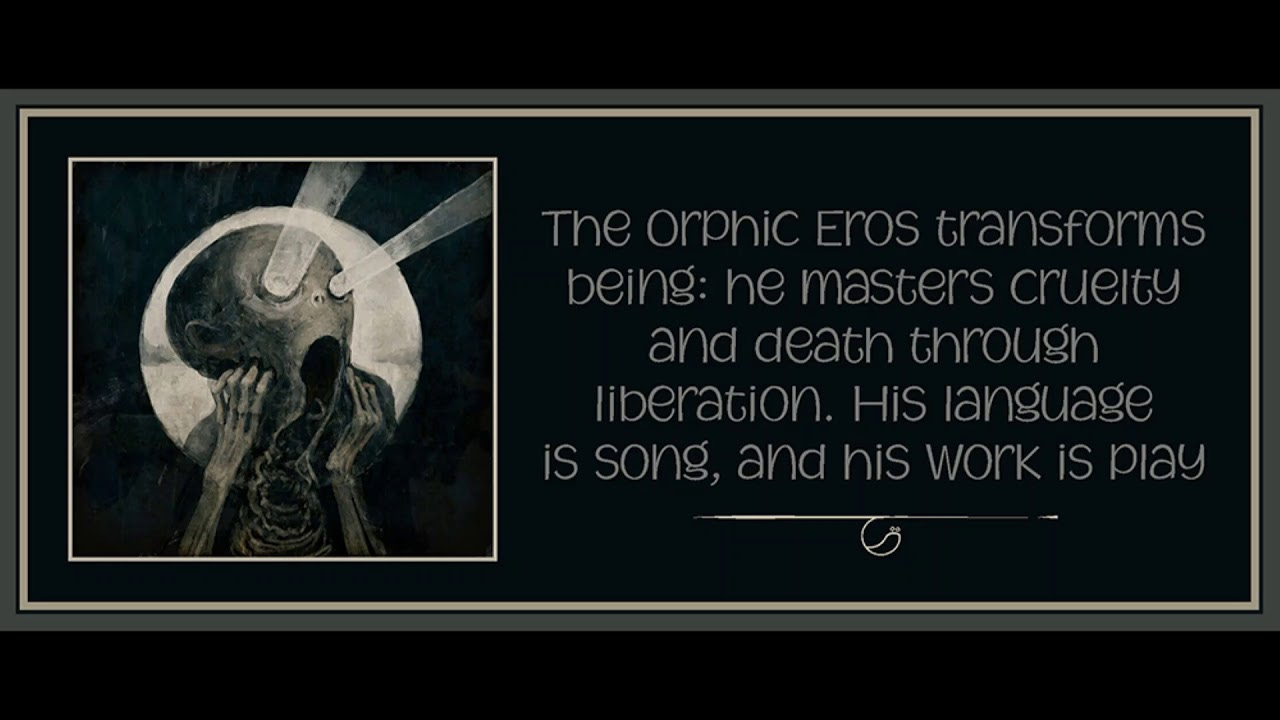
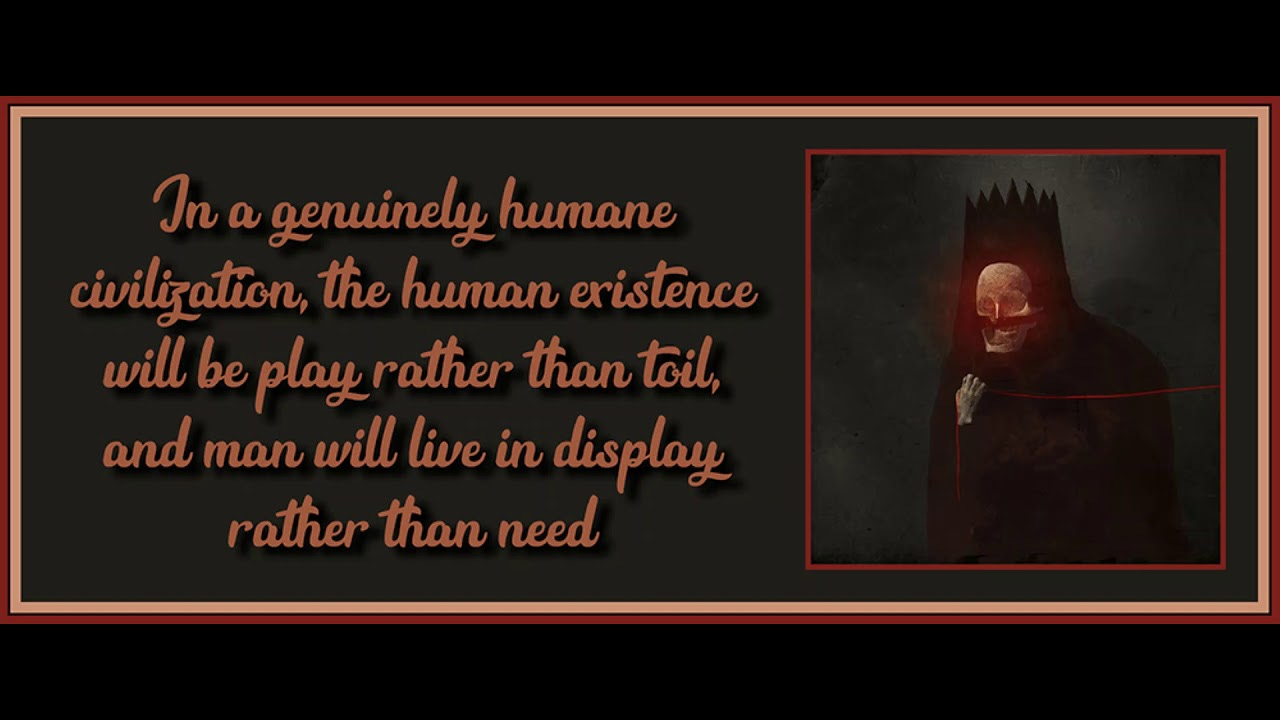
The above quote, from Herbert Marcuse (‘Eros and Civilisation’, p. 171), forms a kind of conclusion to his discussion of Orpheus and Narcissus as a liberating response to a repressive society. Marcuse’s book is a critical analysis of Freud’s psychological theory concerning the individual and society, and in particular the way in which society represses the individual (in particular through repression (and, in a sense, manipulation - for its own ends) of the libidinal instinct). Freud also however sees this repression as necessary for the maintenance and progress of ‘civilisation’ - in essence he shows little or no faith in human nature of course, in reducing everything to unconscious or biological drives within the psyche (as well as to certain supposed childhood experiences/traumas1) his version of psychology shows just as little respect for human will, human freedom and human choice.
There are in fact, before we get too pulled in by things, many different ways in which we can pursue our discussion of the above quote; and all of them reveal something. It is undoubtedly true that the Orphic Eros is a liberating force; but this is so on many different levels, and our discussion, though it cannot - in this short space - account for all of them, we must look at a few in turn, without getting them entangled (though of course they are relevant to each other). Firstly we can look at the thought of the Orphic Eros in direct relation to Marcuse’s own idea and use of it, and secondly we can take a more purely philosophical look at it, with regard to the individual regardless of whether or not she or he is suffering from a sick society2. This is the order in which I shall address the question in this short essay.
Before this however it is worth taking a short historical look at the Orphic Eros. For it is undoubtedly true that, even in its original days in Greek society it was a liberating force (and we shall meet this fact throughout our discussion). Orphism always appealed to the poor and the repressed. It is worth quoting here a few short passages from Burkert3:
‘Liberation from former distress and the pressures of everyday life, an encounter with the divine through an experience of the force and meaning of life, are present in Dionysiac initiation.’ (p. 293)
‘The wandering Orpheotelestai [Orphic initiates] were themselves sometimes no better off than beggars. Thus Orphism, like other sects, probably appealed to the class of the small man most of all.’ (p. 302)
We do not here need to testify to the repressive and barbaric character of orthodox Greek society and religion, but Burkert also testifies to the fact that Orphism was an active force against societal repression, even if we can’t go as far as saying an open rebellion against it4:
‘Behind these innovations there is clearly an impulse directed against the nobility, which comes from the lower classes of craftsmen and peasants from whom the tyrants drew their support.’ (p. 290)
‘Dionysos is the god of the exceptional. As the individual gains in independence, the Dionysos cult becomes a vehicle for the separation of private groups from the Polis.’ (p. 291)
Perhaps one good reason for mentioning this is the thought that such an Orphic way of life (and of thinking about life) would still be liberating today;- and even in its original form. As we shall see one of the main repressive forces at work in modern society is on the one hand an alienation from nature - the Orphic Eros - in the personage of Orpheus himself - clearly embraces nature - and on the other hand an atheistic fear of death - Orpheus’ descent to the underworld clearly makes a mockery of modern fears of death. But this of course is to enter into the more philosophical side of the matter, which we said we would leave until the second part of the essay. Suffice to say that orthodox Greek thought emphasised the gulf between mortals and the gods - it was generally unthinkable for a Hellene to ‘imitate’ a god - and the mystery cults (Orpheus and Dionysus etc.), with their goal of oneness with the god (invocation), clearly bridge this gulf. In this sense the Orphic Eros can be easily identified with the Platonic Eros of the Symposium5, which is a daemon - i.e. having access to both the divine and the mortal worlds, and travelling between the two.
There is also, relevant to this stage of our discussion, a very interesting and revealing point which Dodds6 makes concerning the myth of Dionysus and the Greek mentality. In his chapter entitled ‘The Greek shamans and puritanism’7 he effectively shows that puritanism and the doctrine of original sin were quite prevalent in Greek religion and thought (as for his speculation that it originated there, we can dispute that by looking also to the Judaeo-Christian), but perhaps most importantly he links the guilt of original sin to the slaying of Dionysus (by the Titans - the ancestors of mankind). This becomes clearer when we at once realise that, philosophically, Dionysus in a sense personifies the ‘superman’, the end of human evolution, the ‘becoming of a god’ (hence the imitation/invocation). Thus rejecting Dionysus (a similar thing happened to Orpheus, of course), slaying him prevents man from becoming a god and creates a gulf between the mortal and the divine8. The Orphic and Dionysiac mystery teaching thus is liberating because above all it preaches union with the god - the initiate’s goal is always imitation (invocation) of and identification with the god. This is one reason, of course, why Nietzsche constantly made use of Dionysiac imagery and myth, and was fond of this thought. Indeed, we shall be ending our essay with a quote from that man.
So much for the historical evidence that the Orphic Eros is liberating. Now we must come to Marcuse. Marcuse works against the repressive nature of society on two levels - firstly, simply, he criticises Freud’s psychology (of the biological individual) because this psychology itself is based on the effect of society on the individual (i.e. it is ‘second-hand’, not natural), and secondly he identifies the ways in which society is repressive. In respect of the former, this shows great insight on Marcuse’s part:
‘Freud was fully aware of this discrepancy [sic. (as it were) in psychotherapy], which may be formulated (much oversimplified) as follows: while psychoanalytic theory recognises that the sickness of the individual is ultimately caused and sustained by the sickness of his civilisation, psychoanalytic theory aims at curing the individual so that he can continue to function as part of a sick civilisation...’ (p. 245)
I think this speaks for itself. But of course it goes deeper. As I intimated earlier, Freud displays little respect for freedom of the will or indeed the mere fact of the possibility of evolving. And this is true of psychoanalysis itself - above all, by positing ‘conditions’ and ‘functions’ it denies the possibility of overcoming (not to mention the autonomous individual). Psychoanalysis is, in effect, only for the sick9. To re-enact a Nietzschean sensibility, in the healthy individual that which does not kill us makes us stronger - all obstacles are there to be overcome - in the sick and repressed individual, as in the sick and repressive society, the formula becomes ‘that which does not kill us, makes us weaker’. The Orphic Eros liberates because it is at one with this facet of nature, it cares not for psychological orderings and definitions but instead is completely free. In essence, there comes a time when we must realise that we are perfectly fine, that all our supposed ‘problems’ are in fact not ours at all, but are projected on to us by other, sick individuals in a state of denial. Freud’s psychoanalysis is itself sick and repressive because it is the product of a sick and repressive society - it speaks with the voice of society10. By saying ‘I have never had an Oedipus complex; I am fully aware of myself; I, like Orpheus, have journeyed into the abyss, the underworld, my own unconscious; I am at one with myself and thus not subservient to myself - I am - following Heidegger - fully out and contented in the Open.’ one inherently overcomes this psychoanalysis, as well as society.
But Marcuse, of course, also criticises the repressive reality principle of society by identifying the areas of its repression. And these are in effect nothing to do with any so-called psychological factors but are instead purely practical and self-evident. In order for (modern) society to function we must work - we must sacrifice our own desires, our own individual needs and perform work which in essence we do not like (for the good of the whole/society; this ideal of productivity he calls the performance principle). And as individuals we know we shouldn’t need to do it. We simply do not have the time or the opportunity to pursue our own desires or interests, and so they must be repressed. Psychologically however it is also that - according to Freud at least - many of these instinctual desires (especially that of Eros) are destructive to society, and thus must be repressed11. This then creates frustration which of course in turn must be repressed.
Rather than get dragged in to an overly detailed elucidation of this however, let us allow Marcuse to speak for himself:
‘The concept of man that emerges from Freudian theory is the most irrefutable indictment of Western civilisation - and at the same time the most unshakeable defence of this civilisation. According to Freud, the history of man is the history of his repression. Culture constrains not only his societal but also his biological existence, not only parts of the human being but his instinctual structure itself. However, such constraint is the very precondition of progress... The instincts must therefore be deflected from their goal, inhibited in their aim. Civilisation begins when the primary objective - namely, integral satisfaction of needs - is effectively renounced.’ (p. 11)
For Marcuse however, it is perhaps not the reality principle itself which is repressive, but the reality principle in its current, historical form which is repressive. He designates this the ‘performance principle’. Where the reality principle (associated with Prometheus, in that myth) was originally non-repressive, in the sense that mankind (like the ego) was once at one with it, since it was part of nature, historically through western culture it has become repressive as the performance principle:
‘Repression is a historical phenomenon. The effective subjugation of the instincts to repressive controls is imposed not by nature but by man.’ (p. 16)
Having elaborated this, Marcuse then goes on to speculate on the possibility of a non-repressive reality principle, which is attained through the liberation of Eros - in particular the Orphic Eros.
But firstly of course we can ask the question, what is ‘culture’, and ‘civilisation’? Is not civilisation and culture supposed to be mature, and un-repressed (civilised?!)? Is the modern repressive reality really civilised? When we realise the above quote, that the performance principle is man-made, not nature-made - unnatural - we begin to wonder. It is man, not nature, who provides the cruelty which must be mastered. Marcuse makes this point too, and asks this question:
‘The definition of the standard of living in terms of automobiles, television sets, airplanes, and tractors is that of the performance principle itself. Beyond the rule of this principle, the level of living would be measured by other criteria: the universal gratification of the basic human needs, and the freedom from guilt and fear - internalized as well as external, instinctual as well as “rational.” “La vraie civilisation... n’est pas dans le gaz, ni dans la vapeur, ni dans les tables tournantes. Elle est dans la diminution des traces du péché originel.”12 - this is the definition of progress beyond the rule of the performance principle.’ (p. 153).
Here we see one way in which the Orphic Eros is liberating - as we saw from Dodds the Orphic and Dionysiac mysteries not only reduce but effectively remove all traces of original sin. And of course by identifying with the murdered god, these Orpheotelestai identify themselves as the repressed, the true children of nature repressed by the unhealthy, and speak - or sing - out against it. They liberate themselves. ’What are poets for in a destitute time?’ asks Heidegger13, when - ‘The default of God forebodes something even grimmer, however. Not only have the gods and the god fled, but the divine radiance has become extinguished in the world’s history. The time of the world’s night is the destitute time, because it becomes ever more destitute. It has already grown so destitute, it can no longer discern the default of God [Atheism? The fear of death?] as a default.’
He replies (p. 94) - ‘Poets are the mortals who, singing earnestly of the wine-god, sense the traces of the fugitive gods, stay on the gods’ tracks, and so trace for their kindred mortals the way towards the Turning [towards the Open].’
Orpheus, by venturing into the divine world (underworld), and constantly charming and celebrating nature with his song and poetry, once more expresses the divine that has left the world of the performance principle, and the freedom of man when he is in harmony (harmonia) with nature, and the natural order of things:
‘The Orphic and Narcissistic experience of the world negates that which sustains the world of the performance principle. The opposition between man and nature, subject and object, is overcome. Being is experienced as gratification, which unites man and nature so that the fulfilment of man is at the same time the fulfilment, without violence, of nature.’ (Marcuse, p. 166)
But of course this is not anarchy - in a sufficiently advanced age we have reached a point where the requirements of work and production can be met far more efficiently, leaving time to pursue our natural and instinctive desires. Here work becomes play, and thus - by virtue of its satisfying nature - unrepressed. Culture - in its true sense - reveals itself:
‘The Orphic-Narcissistic images are those of the Great Refusal: refusal to accept separation from the libidinous object (or subject) [as in Primary Narcissism/the oral phase]. The refusal aims at liberation - at the reunion of what has become separated. Orpheus is the archetype of the poet as liberator and creator: he establishes a higher order in the world - an order without repression. In his person, art, freedom, and culture are eternally combined. He is the poet of redemption, the god who brings peace and salvation by pacifying man and nature, not through force but through song:’ (p. 170).
Thus, to summarise this part of our discussion, the quote from which it originated:
‘The classical tradition associates Orpheus with the introduction of homosexuality14. Like Narcissus, he rejects the normal Eros, not for an ascetic ideal, but for a fuller Eros. Like Narcissus, he protests against the repressive order of procreative sexuality. The Orphic and Narcissistic Eros is to the end the negation of this order - the Great Refusal. In the world symbolised by the culture-hero Prometheus, it is the negation of all order; but in this negation Orpheus and Narcissus reveal a new reality, with an order of its own, governed by different principles. The Orphic Eros transforms being: he masters cruelty and death through liberation. His language is song, and his work is play. Narcissus’ life is that of beauty, and his existence is contemplation.’ (p. 171)
Marcuse of course does not really view the Orphic Eros in terms of the mystery religion of Orphism, but more in terms of merely the personality and actions of Orpheus himself (but, in this, still more as a poet than a shaman). But in neglecting this more mystical aspect of Orphism, Marcuse perhaps neglects a more powerful liberator. For - as he apparently fails to notice - in effect the Orphic Eros does not merely liberate us from a repressive society, but it also liberates the individual from psychoanalysis itself.
Here we come to the second aspect of our discussion. Here we are not concerned with viewing things in terms of any psychological definitions or reality principles or repressive societies as such, but are instead concerned with the fate of the individual per se - in any situation. Why - or how - does the Orphic Eros master cruelty and - more poignantly - death? For it is only with the mastery of death that we can hope to achieve true liberation. For to see the repressions of reality solely in terms of a ‘performance principle’ - work, labour, repressed instincts and the like - is perhaps too superficial - there are deeper factors at work here. So far we have identified the cruelty of man - the repressed, unhealthy, sick man - and put forward the thought that nature herself is not cruel - when we are at once at one with her; and we have shown how Orpheus - the Orphic Eros - is in harmonia with nature (cosmos, dike) (we could even say, in love with nature). But undoubtedly one of the major factors at work here is the fear of death. And also of pain - for the ‘death instinct’ is also a desire for a release from pain. But of course (in the modern mentality at least), death and pain go together - thus arises a conflict (cf. also the Nietzsche quote below). In Orphism, Eros and Thanatos are one - by conquering death, one conquers pain. The Orphic Eros does not just merely master death, it transcends it (as with the Platonic Eros of the Symposium, where it wills the desire for immortality). Among other things, Orpheus’ descent into the Underworld shows that death is not final (ker), but that life - Being - continues beyond it (thanatos).
But rather than get dragged into mystical pronouncements about life after death, in keeping with the nature of our discussion it suffices to approach it psychologically. Originally, man had no fear of death, the divine world was present and attainable. The Ego (of the reality principle) was at one with this. Marcuse (p. 168) quotes Freud in this:
‘Originally the ego includes everything, later it detaches itself from the external world. The ego-feeling we are aware of now is thus only a shrunken vestige of a far more extensive feeling - a feeling which embraced the universe and expressed an inseparable connection of the ego with the external world.’ (Freud, ‘Civilisation and its Discontents’, p. 13, italics added)
This is what Freud refers to as ‘Primary Narcissism’. (Thus, by that oneness with nature, the narcissistic, as well as the Orphic, Eros is liberating.). This reconciliation of the for-itself with the in-itself is the same as ‘becoming god’ - which is the goal of the initiate in the mysteries. Much of the fear of death, as well as atheism, is in a sense a product of what Freud referred to in ‘Moses and Monotheism’ as ‘the compulsion to worship a god whom one cannot see’. It is a dissociation, in other words. In psychological effect there is little to distinguish between the Greek religious view of the gulf between man and god (or the inexpressibility) of the Platonic forms) and the Judaeo-Christian view of an invisible, wrathful god15 - they both prolong man’s mortality and alienate us from the divine and the nature which those gods personify/represent (and likewise the unconscious/Underworld). In primary narcissism, as also in the mysteries where the initiate identifies with Dionysus (like Narcissus, the child with the mirror, seeing himself in nature and thus realising his oneness with nature) or with Orpheus, one also becomes one with ‘all’ or ‘god’ (an intoxication/loss of self; but also liberation). It is this attainment of divinity which is the way the Orphic Eros transcends death.
Atheism of course represses the fear of death because one simply ‘puts up with’ the supposed fact that death is the end (and not a welcome beginning). It serves the society in this respect. The knowledge of life beyond death - which is the Orphic knowledge - would thus destroy such a society and liberate us from its performance principle, from its repressions. Of course we cannot here enter into discussions of such mystical (or mythical) nature - suffice to say that this is the Orphic Eros, and that these things have a psychological (psychohistorical) effect, whether it be for repression or for liberation.
But, as promised, we will allow Nietzsche16 the last word on the matter:
‘What did the Hellene guarantee to himself with these mysteries? Eternal life, the eternal recurrence of life; the future promised and consecrated in the past; the triumphant Yes to life beyond death and change; true life as collective continuation of life through procreation, through the mysteries of sexuality. It was for this reason that the sexual symbol was to the Greeks the symbol venerable as such, the intrinsic profound meaning of all antique piety. Every individual detail in the act of procreation, pregnancy, birth, awoke the most exalted and solemn feelings. In the teachings of the mysteries, pain is sanctified: the ‘pains of childbirth’ sanctify pain in general - all becoming and growing, all that guarantees the future, postulates pain... For the eternal joy in creating to exist, for the will to life continually to affirm itself, the ‘torment of childbirth’ must also exist eternally... All this is contained in the word Dionysos... It was only Christianity, with ressentiment against life in its foundations, which made of sexuality something impure: it threw filth on the beginning, on the prerequisite of our life...’
BIBLIOGRAPHY - for those who are really interested, all of these are highly recommended! &, dare I say it, a must-read. Also, a nostalgic insight into the state of play in the 1990s.
Burkert, W. ‘Greek Religion’ (Harvard Univ. Press, 1985)
Dodds, E. R. ‘The Greeks and the Irrational’ (Berkeley, 1951)
Graves, R. ‘The Greek Myths’ Vol.1 (Penguin, 1955)
Heidegger, M. ‘Poetry, Language, Thought’ (Harper and Row, 1975)
Marcuse, H. ‘Eros and Civilisation’ (Routledge and Kegan Paul, 1987)
Nietzsche, F. ‘Twilight of the Idols/The Antichrist’ (Penguin Classics, 1990)
Like the example of the girl who was afraid of horses, which Freud proclaimed was down to her father, until it turned out she’d had a bad experience with a horse when she was younger.
In a sense we can posit a maxim - ‘only by each person bettering themselves can society or the human (or any) race as a whole progress’. Perhaps things would be better if people simply were a) nice to each other and b) took responsibility for their own lives instead of abdicating that responsibility all the time (to courts, laws, governments, criminals, angry gods etc.).
Walter Burkert, ‘Greek Religion’ (Harvard Univ. Press tr., 1985). In the following quotes (and, indeed, in the whole essay) we shall bear in mind the fact of the close relation between Dionysiac and Orphic. There is little philosophical difference between them.
This of course is one reason for the persecution of such sects (now and then - cf. witch-hunts etc.), including the Pythagoreans, who in effect were merely more philosophically minded Orphics (who certainly took part in politics).
As well as the fact that Diotima speaks in the language of the mysteries, Plato of course was greatly influenced by the Pythagoreans, who were largely Orphic. Thus it would not be surprising if Plato’s Eros was also Orphic.
E. R. Dodds, ‘The Greeks and the Irrational’ (Berkeley, 1951); cf. especially pp. 151 ff.
The shamanic aspect of the mysteries is well attested - Orpheus’ descent to the Underworld alone is reminiscent of the shaman’s ritual journeyings to the unconscious and the ‘other side’.
As with Plato’s theory of forms, in which there is also an unbridgeable gulf between the two worlds. When we consider Plato’s Pythagorean/Orphic influences, we can perhaps see this rejection (of those influences as well) - this original sin - in Plato’s own philosophy - which, it must be said, is undeniably puritan.
Or the ‘evolutionary throwbacks’; just as with Christianity ‘this church is only for sinners’. Nature does not legislate for such people; and neither should we.
Marcuse, p. 6 - ‘In shifting the emphasis from the unconscious to the conscious, from the biological to the cultural factors, they cut off the root of society at the instincts and instead take society at the level on which it confronts the individual as his ready-made “environment” without questioning its origin and legitimacy... Consequently, the Neo-Freudian critique remains in a strict sense ideological: it has no conceptual basis outside the established system; most of its critical ideas and values are those provided by the system.’ [italics added]
Marcuse, p. 95 - ‘In a world of alienation, the liberation of Eros would necessarily operate as a destructive, fatal force - as the total negation of the principle which governs the repressive reality.’
“True civilisation does not lie in gas, nor in steam, nor in table-turning. It lies in the reduction of the traces of original sin.” (Baudelaire, ‘My Heart Laid Bare’, 1897 – ‘table-turning’ here is a reference to spiritualist seances, not DJing, in case you were wondering). cf. also what we previously observed after Dodds’ remarks about the Greek original sin.
Martin Heidegger, ‘Poetry, Language, Thought’ tr. Albert Hofstadter (Harper, 1975) p. 91.
I would seriously question this attribution of homosexuality to Orpheus and Orphism - everything about the myth speaks of true love between a man and a woman - she fights off the advances of another man - Aristaeus - he ventures into the underworld to rescue her (there have been suggestions that originally Orpheus was successful in rescuing Eurydike, and that Greek moralising suppressed this, to emphasise the gulf between mortal and divine), and remains faithful to her after she is gone, which is one explanation why he is killed by the Thracian women, for refusing them. We must also remember that Orphics were of both sexes (‘Wise men and women’) and that one of the acusmata of the Pythagoreans was - ‘Outstanding among the purely moral prescriptions is that in contrast to normal practice the husband is forbidden extramarital sexual intercourse.’ (Burkert, op. cit., p. 302).
And these are two of the main factors in which western civilisation finds its foundations/roots.
Friedrich Nietzsche, ‘What I Owe to the Ancients’ in ’Twilight of the Idols’ (Penguin Classics, 1990) p. 120, 121).
Click here for next edition of Fairytale Sunday
This is really bold, radical stuff. Bravo! Such an interesting, syncretic, flowing analysis. It reminds me a bit of Rieff's "Triumph of the Therapeutic," but with more mythological grounding and a friendly wave to the Frankfurt School.
So many rich ideas to dig into here! As a former art historian, I have a surface-level understanding of philosophy and classical myth as so much of both of these fields has played into art through the ages. I, too, find pre-raphaelite art to be among the most symbolic and thought-provoking. All though I may be biased because my thesis advisor was a pre-raph specialist! I was also struck by the idea of Pygmailion being more narcissistic than Narcissus! I never thought of it that way, but it's true!