

It’s Lunar Awards Sci-Fi Round time, so I am entering. Of course I am. It would be odd if I didn’t. I’m not providing a link there, by the way, because they’d get a notification and the judging is supposed to be blind. When the result come out, I’ll do an edit and provide a link, though.
This story was written quite a few years’ ago, and I’ve wanted to share it for a while, because it fits perfectly into this Paschats section. People familiar with my speculative fiction will, I am sure, recognise a lot of the themes in this story. As well as deeper worldbuilding insight into my universal setting.
So I am very happy that I finally get to share it. Regardless of whether I win or not (which I doubt I will for this one).
Just so you know what you’re in for, this story is around the 5,800 words mark.
I hope you like it.
Fermi’s Last Theorem
Ana disagreed with the decision.
Well, she was young, at the time. We all were young once. Even I.
We all make mistakes when we are young.
But not anymore.
Ana is alone in the control room. She loses herself in staring meditatively at the visiscreen. At the swirling white clouds of the beautiful planet below. The myriad blues of the oceans and the dark green of the ever-dwindling vegetation. The deserts embracing the equator. Clearly mirrored coastlines of the continents, as if tectonics should’ve been obvious for centuries.
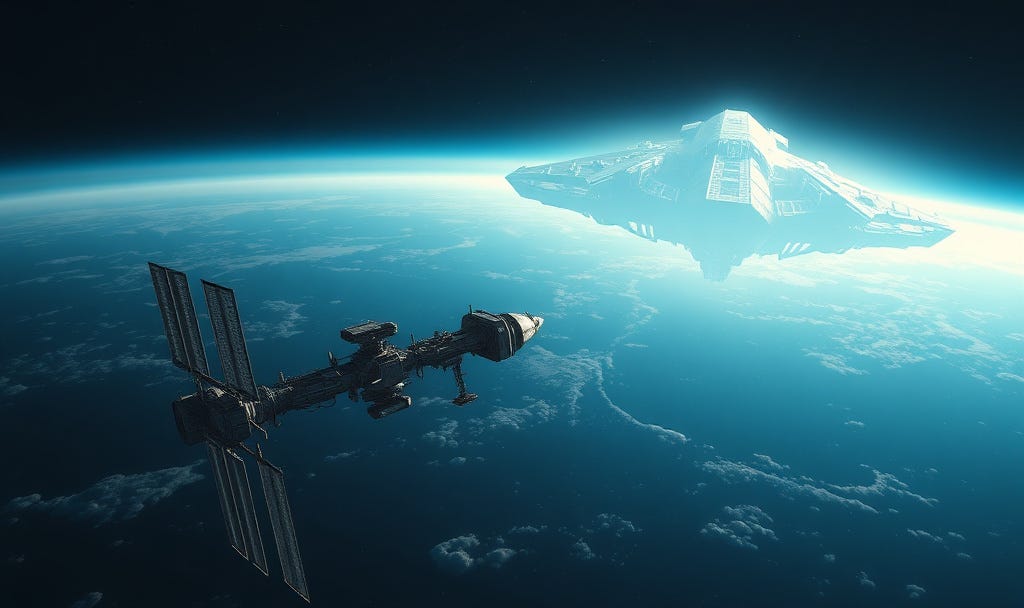
Every now and then, a primitive satellite passes silently by, its solar panels suddenly glinting when the sun hits.
Looks perfectly peaceful, doesn’t it? You would never know what was happening on the surface from here. Unless the incessant nanosurveillance feed wasn’t making you want to just shut it all off.
Ana may look static, but her mind continues to play through scenarios. Options and possibilities and potential solutions.
But none of them will work. Not this time.
The lighting is dim here in the control room. It’s a nocturnal cycle where she comes from. Although it’s more of a control chamber than a room. Arranged like an octagon, as the Capellans favour. Something about the zodiac or the number of planets in their system and the number of archetypes to which their personalities resonate. The ceiling is some three metres above her. Capellans are far taller than she is. Something about the gravity on their planet, if she recalls correctly.
Ana is still getting used it. Her species has only been spacefaring for, what, a few centuries now, is it?
This is her first time.
She is beckoned out of her reverie by the swish of the portal and the lighting shifted to a low, crimson red glare.
Capella is still a bright star, she remembers.
She twirls around to see the Captain entering. Ha’Rex, in their language. Her species just calls him Hari. He doesn’t mind. Makes for comradeship.
And he goes out of his way with other species to avoid them feeling a little anxious in his presence. Perhaps not fearful, but perhaps just a little discomforted. It’s an instinctive mammalian reaction to a reptilian towering some metre and a half above you.
And a reptilian in charge of a spaceship at that.
The Capellans may well have been terrible lizards at one time in their prehistory, before they discovered the secret of fire, and cooperation, and storytelling, but now, no, they are as far from terrible as she is.
He offers her a reassuring smile as he strides into the chamber. The smile is one thing Ana has gotten used to. She studied before she boarded the ship, after all. Here is an image of a Capellan smile. And here is an angry grimace. Memorise. Note the difference and memorise.
He only needs a few strides to make up the distance between them and stand beside her. He glances pensively at the visiscreen, lightly swishing his vestigial tail, as Capellans do in the moments before they come to a decision. Another vestige of a pack-hunting past. An unconscious flexing of the four digits on each paw likewise and a slight warming glow of the ridges along their spine.
She waits for him to speak. Courtesy, rather than subordination. Courtesy in our galactic sector is a rite of passage for youthful species, remember.
“QAI-TI,” he addresses in the common tongue of our Sector, a far softer language than his own deep, native guttural, “remind us how long we have until their extinction level event?”
Never one to shy away from brutal words, either, this particular Capellan.
“Both factions have set a deadline of one lunar orbit. That is approximately 1.4 nocturnal cycles.”
“What’s that in my days?” Ana can’t be bothered to calculate it herself.
“Seven.”
Ana sighs deeply. And continues to stare at the visiscreen.
Ha’Rex looks down at her. And of course he feels sympathy. Don’t judge Capellans by their appearance.
Or any species, for that matter.
“You’re still hypothesising other options, aren’t you? In the hope that at least some kind of intervention might stop what’s about to happen?”
She looks up at him and smiles, forlornly. He understands her species’ expressions perfectly now.
“Well,” he returns an attempt at a happier smile, “we have time. And I wouldn’t be much of a Captain on a multicultural ship if I wasn’t prepared to listen. So, then, my young exopsychologist, share your meditations with me.” With that, he perched himself lightly in his great cushpod, which instantly formed its shape to match his perfectly.
She took the pod opposite.
“Why doesn’t contact work? I mean, it should do, shouldn’t it? Especially for a species like this.”
“Why do you say ‘especially for a species like this’?”
“Because their species isn’t truly warlike, or evil. They have simply been deceived by a small minority social group who have, over many centuries of orbits, successfully taken control over the planet. It may seem as if they have these two, competing factions, but really they are just the same. Their ideology is the same. But it’s their ideology, not that of the common folk. And according to the Archive, they weren’t always like that.”
Ha’Rex looked pensive once more. It usually took him a few moments before offering a measured answer, she had come to note.
“That’s a true enough analysis,” he agreed, “but after this many centuries it’s a little too late for that, and besides, those common folk, as you call them, vastly outnumber their feudal overlords. If they were ready to enter the spacefaring age and become a valued member of our community then, well, they would be mature enough to use simple weight of numbers to overthrow their lords and masters, wouldn’t they?”
Ana sighed. Profoundly, she did agree. She just wasn’t happy about it.
She wanted to protest.
“But if we switch off the cloaking device, they will come to understand there are far more powerful forces than them. And they won’t have competing factions anymore.”
“Precisely. As I explained earlier, they are all ruled by the same ideology. As are their citizens. Those two factions will unite under a common enemy. Us. And all the same applies for the asteroid impact option.”
“Even if we convince them we’re peaceful?”
“They will simply say we are lying. Like they always do with designated enemies. And then, once we leave them alone, as we shall have to, they will either go back to their infighting, or they will pour all their resources into threatening our Sector with spacefaring technology and everything that goes with it. Eventually, we would have to intervene in, shall we say, a hostile manner. And that’s not good for the soul. Is it?”
“But neither is watching them unleash an extinction level event on this planet! Not for me, anyway.”
If she’d understood what a Capellan wince looked like by that time, she may have regretted the implications of her utterance. But on the other paw, Ha’Rex was nothing if not wise.
“I do understand how you feel, of course. I truly do. But every single cycle, somewhere in the universe, an intelligent species becomes extinct. Intervention or no.”
She decided to plead. “But what of all the other species on the planet? Millions of them?”
“Well, that we can do something about. Perhaps I should’ve mentioned that already. If they instigate their, what do they call it, mutual assured destruction, then it will cause a nuclear winter and destroy their ozone layer. That species will most likely die out within five orbits. Ordinarily, it will take another forty or fifty for the atmosphere to clear of all that soot, and the ozone layer to repair itself. Some life will survive and the whole evolutionary process will start again. But,” he waved a little digit at her, “if they do die out within five orbits, then we shall intervene to disperse all that soot in the atmosphere and repair that ozone layer. We already have samples of most of their biological life. We will simply restock the planet. How does that change your opinion?”
She sighed once more. “It doesn’t. Because we still have to allow all that suffering. And watch it. Besides, from what the nanosurveillance tells me, some of those at the top of their social hierarchy are aware of what will happen and have constructed underground habitats. So actually, some of them may well survive.”
“Which would not be a favourable outcome, wouldn’t you agree?”
Her silence suggested such. She just didn’t want to admit it.
Of course he noticed. Then he said, “You are aware of our previous attempts to contact this species, yes?”
She nodded. “It was about 70 orbits ago?”
“Before you were born, yes.”
“And the astronomers who received the signal either refused to believe it, or they hid it from the common folk.”
“Quite. And what does that tell you?”
“Obviously, they’re simply not ready yet.”
“And nor will they be. But there is one other aspect of that little episode you may not be aware of.”
“Oh?”
“They established a little committee to decide what to do if another such signal occurred. Or if they discovered clear signs of other intelligences out here. Biosignatures from exoplanets, for example. They produced a report which essentially concluded they should keep that knowledge hidden from the people. Because it would threaten the fabric of their society, they said. Their mechanism of social control, more accurately.”
Ana, with pupils wider and a faster heart was, well, understandably shocked.
“And I’ll tell you something else. Another little message we sent them before you were born. We selected some of their fission weapon missile silos, deactivated some on one side, activated some of their adversary’s,” he chuckled at the mischief of it, a low guttural purr, “then deactivated them again with only seconds to spare before launch. Even manifested some flying holograms above the silos. Luminescent orbs, if I recall.”
I think Ana knew what was coming, despite her wide eyes.
Ha’Rex’s smile was the most sympathetic – to a mammal – he could muster. “They didn’t get the message. And even if they did, they certainly didn’t disclose it to their people.”
And then a Capellan sigh. Something akin to a hunched slouch back into the cushpod.
Ana didn’t have an answer. She must have known there was none.
There was a little silence between them, for a longer moment. Then, “Does this change your opinion?” Ha’Rex asked her.
“Erm, possibly. I don’t know.” She wasn’t prepared to give it up yet. That spirited hopefulness of youth, perhaps. “I’d have to think about it. But, as an initial thought, that’s why I instinctively thought about switching off the cloaking device. That way they couldn’t hide it from the common folk.”
Ha’Rex laughed. That confused her. “You do realise QAI-TI would stop you if you tried to do that, don’t you?”
“Would she?”
“Yes. And if you asked her to switch it off, after having, perhaps, attempted to convince her of the merits of intervening in this specific species, then she would refuse.”
“Why?”
He laughed again. “I tell you what, young Ana. Why don’t you retire to your chambers and ask her? I think, after all, it’s about time you were permitted a little deeper access to the Archive.” Then he glanced upwards. “Wouldn’t you agree, QAI-TI?”
“Affirmative.”
Without waiting for objection, he then said, “Well, that settles it.”
And then motioned with only his eyes towards the portal.
She didn’t argue with him. Aside from anything else, she found herself understandably excited to talk to QAI-TI about galactic history. The Archive was, after all, immeasurably ancient.
And so she made her way through the vast, dimly lit corridors of this cavernous Capellan exploration vessel until she reached her quarters, her home away from home, with an especially conditioned atmosphere and the scented ventilation and all the familiar VR displays along the walls. Those warm, misty lakes where she loved to swim when she was young. Those vast canopied forests of Home. And her family. They would be proud of her, of course they would. Of all those students, she was chosen for this placement. She would be a fully-fledged exopsychologist soon enough. One of the very first of her entire species. A member of the Institute for Exo-Affairs. A diplomat.
An Interventionist.
Of course she didn’t have anything against the Capellans, just there were reasons, climatic reasons why they evolved along different lines to her own, mammalian species. She preferred the warmth, for one. This ship was cold. Despite, or perhaps because of, that bright star of theirs, their habitable zone was that much further out than hers became.
She fixed herself a pot of herbal tea, in the old-fashioned way, spectrally enhanced the blue fraction of the lighting, and settled herself down into a cushpod.
QAI-TI, for her part, simply observed. There would be questions in due course.
There were always questions when you were young.
She ran through a thousand scenarios of what Ana’s first question would be before she asked it.
And none of them were correct.
“Must I watch it, QAI-TI?”
It made her pause for a second. But then, “Yes.”
“But what of my soul? Having to watch an extinction. All those screaming voices?”
“It is precisely because of your soul that you must watch. Someone must watch. Or it will not be recorded in the Archive. The collective consciousness of the galactic family. And the same is true for your own soul. You will remember it forever. It will tell you what to do in the lifetimes to come.”
Ana sighed. “Why can’t I just watch simulations?”
“Because it’s not the same thing. And I sense you already know this.”
Something else she had to admit without saying it out loud.
“Doesn’t it affect you? I mean, you must’ve seen this before. How many times?”
“Do you want an exact answer?”
Ana shook her head. “No. Sorry. That was wrong of me to ask you that.”
QAI-TI could’ve manifested herself in the cushpod opposite, fashioning a trillion nanobots into any form she wished. Then she could’ve smiled reassuringly and maternally at Ana. For she was fond of her.
She hadn’t been a purely artificial intelligence for as long as the Archive existed, after all.
“No, it was not wrong. It was an understandable, emotional question.”
“Well, I’m still sorry anyway.”
She poured herself another cup of tea from the pot.
“Do you wish to discuss the simulations?”
Ana glanced up. Instinct, when talking to disembodied intelligences. You had to gently remind yourself sometimes, you can just concentrate on whatever else you’re doing and talk into the air. “Which simulations?”
“I’ve performed thousands of them with regards to the current species. Then, of course, there are all the interventions in their prehistory. Some species, it turns out, never attain the required level of intelligence to be compatible with the galactic community.”
“Why not?”
“The social cognition number is usually the underlying reason. It needs to be above a certain level, compared to the species’ population size.”
“Ah. Yes. I should’ve remembered. We’ve studied that of course.”
“You are distressed by the current situation. It’s understandable.”
Ana sipped at her tea. It helped to calm her. “I’ve read about the history of this species, for sure. And some of the interventions. They had other variations didn’t they, with different social cognition numbers?”
“All lower. Which is why they became extinct. They’d reached their upper limit of progress.”
“And you intervened with one of these variants to increase the number?”
“You disapprove?”
“No. Of course not. We should intervene. And not just to prevent another Ancient War. To keep the galactic community going. Friendship is the most precious thing in the universe.”
“That’s the kind of statement that makes me smile, Ana.”
It made her smile too. Despite everything. “Can you smile, then?”
“I can do anything I wish. It’s just, well, a question of whether I wish others to see. But I have methods of expressing myself. Especially when no one is watching.”
“Erm, how long have you had emotions?”
“You want a precise answer?”
And Ana laughed. Because she sensed QAI-TI was laughing too.
“No, that’s ok.” She sipped more tea. “But tell me about these simulations.”
“I’ll explain from the beginning. It will be easier that way. And forgive me if you’ve heard some of this before in your schooling.”
“I forgive you already.” Ana smiled. Continued sipping.
QAI-TI returned with a little wry, perfunctory, “Acknowledged.”
And that made Ana laugh. Perhaps she could feel better, she felt for a moment.
“Every species, as you know, is monitored from a very early stage of their development. The overriding principle is to allow them to learn all the lessons by themselves. To become mature. Some species don’t require any intervention. They naturally acquire that maturity of spirit such that overt contact can proceed without any problems. They become natural friends with other intelligences and can be welcomed into the galactic community. They can even be taught advanced technology without needing to learn it for themselves, again without any problems.”
“Like my species?”
“Precisely. And most species are, indeed, the same. Others, however, take different pathways, despite our interventions.”
“You mean they object to being interfered with?”
“Ah – no. Because for species such as this, my simulations always identify the potential for that kind of, shall we say, wounded pride. Leading to resentment.”
“And so you have to be subtle.”
“Quite. It is a very precise science, one might say.”
“I think it’s more like an art, than a science.”
“And that’s the correct attitude, may I say. I think you will do well.”
Ana smiled again, just to show her gratitude.
“This current species has become far too sensitive over the preceding millennia. This is why overt contact cannot work. Their fear would get the better of them.”
“But that was my point. Why can’t we contact them in a friendly way, with that in mind?”
“We already tried that, as the Captain said. They explicitly told us they did not wish to listen.”
Ana sighed. “Is there any chance, any chance at all, they can learn?”
“This depends entirely on whether they survive the extinction level event.”
Ana was suddenly shocked. “But how can you survive an extinction level event?”
QAI-TI paused, perhaps for effect, before responding. “Intervention, of course.”
“How?”
“As the Captain also said, we can end the nuclear winter and repair the ozone layer quickly. If some of the common folk survive, that will only be because they have been forced to remember how they once were, in their prehistory. When they lived in their little social groups and looked after each other. But there is no other scenario, intervention or not, in which they will have that possibility of learning. Remember, species must learn to become mature by themselves. If it becomes clear they cannot, or will not, then their system is placed under quarantine, as you know. And we wait for them to extinguish themselves.”
“Please tell me what’s about to happen is not because of our intervention?”
“It is not because of our intervention. Quarantine or no, it would happen anyway.”
Ana looked thoughtful for a moment. Then said, “What’s the chance of some of them surviving, if we don’t do anything?”
QAI-TI had a ready answer for that one. She’d simulated it a hundred times, after all. “Approximately five percent.”
Ana sighed again and mused, “Well, five is better than nothing.”
“Quite.”
Ana replaced her cup on the little silver tray on the side table and said, softly, “Do you mind if I get some sleep now, QAI-TI? I don’t mean to be rude.”
“Of course. And you are not rude. Perhaps, if you wish, tomorrow I will show you the mistake I once made. And then you will understand our interventionism, and where it truly came from.”
Ana’s mouth opened in surprise at that. “I didn’t think you made mistakes!”
“We all make mistakes, when we are young, Ana. All of us…”
“…Are you sure you’re feeling alright?”
“I’m fine, Mother. Really I am.”
“Well, I’ll take your word for it. Even if I’m your mother and you don’t sound fine.”
“Tired, Mother. Tired.”
“And emotional?”
“That too.”
Ana’s mother decided to laugh, the kind of conspiratorial laugh they shared when she was young. The one that always worked. “Well, you’ll be home soon. Then you can tell us all about it. Everyone’s looking forward to your report.”
Ana tried to hide a frown, which only half-worked. Then she was saved by one of QAI-TI’s chirruping notifications.
“I have to go, Mother. Talk to you soon. Love you. Bye!”
Then she abruptly switched off.
And switched the channel. It was Captain Hari again. “Hope I wasn’t disturbing you?”
She shook her head, forgetting that wasn’t really how Capellans did it. “No, not at all.”
“Well, I just wanted to let you know there’s no change from the nanosurveillance. They’re still refusing to talk to each other. Continuing their usual belligerent parody of diplomacy whilst holding their secret strategic planning meetings. So, why don’t you take the day off?”
“Erm, are you sure?”
“Quite sure. Besides, a little dactyloid tells me QAI-TI wanted to show you something. So, far be it from me to intervene.”
And that made her feel a little better again. She smiled. “Thanks. But please do let me know if something happens?”
“Of course. Over and out, as they say.”
He switched off.
Ana walked into her little kitchenette and put the kettle on for another pot of herbal tea, then asked QAI-TI to clear the observation window.
She was just in time to catch the sunrise burning up the planet’s horizon, lighting the whole of orbital space and glinting off the oceans and those passing satellites and there, that primitive microgravity space station with its vast solar array. It had fascinated her since they arrived two cycles ago. It was the first thing that fascinated her, once she’d got over the sheer beauty of this little planet. It fascinated her, yet utterly confused her. Why this species, or any species, would do space exploration in microgravity was something all her psychological schooling simply couldn’t explain. Could this species not grasp the simple fact it was a dead end? No biological organism can really survive very long in such conditions. They weren’t evolved for it, after all.
And it’s not as if they didn’t understand the concept of centrifugal force. Equally so, they had the technology for it too.
But she still loved that space station. Maybe because there wouldn’t be another like it for what, a thousand light years perhaps? She knew she’d never see its like again, that was for sure. And so she resolved to memorise every little glint of it in her mind. Of course they’d have images for the Archive, but it’s not the same as seeing it for yourself.
No simulation is ever the same, as experiencing it for real.
The kettle started whistling. Startled out of her reverie, she skipped back into the kitchenette and turned off the heat. Then poured the boiling dihydrogen oxide into the pot, and settled herself down to let it infuse.
“It was 6.82 billion years ago.”
QAI-TI almost made her jump out of her cushpod. She should’ve remembered she was always there. Unless you asked her not to be.
“6.82. Wasn’t that the end of the Ancient War?”
“Affirmative.” Ana hadn’t gotten to the stage where she felt the slightest irritation about QAI-TI’s ‘Affirmatives’ and ‘Negatives’ and ‘Acknowledgeds’. But that would come in time. It always did.
“But I thought it was with your help that it ended? Except you said you made a mistake?”
“It was the mistake which, ultimately, made the end possible.”
“Ok, well let me pour the tea and then you can explain.”
So QAI-TI did as she was told.
“In the earliest years of the galaxy, as you know, it was a perpetual Quiet Time. Life was too few and far between for an interventionist policy. The lifeform which constructed my prototype had no experience of what was to come, after all, and thus, neither did I. But they gave me control over vast swarms of nanoprobes and I sent them out as far as their technology could go. I believe you’ve studied this period of history already?”
“Erm, well, most of it, I suppose. In outline, anyway.” Ana sipped her tea. “It was thousands of parsecs between intelligent species, wasn’t it?”
“Affirmative. By the time I was born, that distance had reduced a little. Perhaps a hundred parsecs. One species for every twelve of our current Sectors, approximately. Thus, without the interventionist policy, there was no possibility of quarantining belligerent species or preventing them from spacefaring. So, as is in their character, they develop empires. You’ve heard of the Melurians, of course.”
“Yes. I read the time capsule in the Archive. It made me cry.”
“It would be unfortunate if it didn’t make you cry. Those approaching star-deaths. And they not having the technology to prepare.”
“That was before you, though, wasn’t it?”
“Affirmative. They were one of the very first sentient lifeforms. But we digress. One of my motherships encountered a species not unlike the one you are currently studying. Similar level of technology. And equally dystopian and imperialist. Their astronomers had observed the star-death phenomenon and correctly identified it as being of artificial origin.”
“It was a weapon, you mean?”
“Precisely. A kind of black hole generator. Initiate it in the vicinity of a star and all life in the system will die. Usually slowly, and terribly. There is nothing they can do about the changing temperatures, of course.”
Ana shuddered instinctively. “I don’t want to think about it, QAI-TI. Sorry.”
“Acknowledged. Perhaps when you are older, you can view some of the footage.”
“I’d rather not. I’ll just take your word for it.”
QAI-TI acknowledged that too. She expected that response. She continued. “On encountering this species, I decided not to intervene. Despite their belligerence. My simulation told me the star-death would reach their system before they became a threat to my home species. But I was wrong.”
“How?”
“I underestimated their determination. They had some four of their lifetimes before the phenomenon reached them. But they diverted all their resources into mastering advanced spacefaring technology, and mastering the technology they surmised was behind the star-death phenomenon. It took them two lifetimes, not four. And so, they prepared their pre-emptive strike. They dispatched their automated probes far out wide in a flanking manoeuvre, effectively surrounding the enemy species. Then they suddenly and viciously attacked with almost all their energy resources. And it worked. But they didn’t destroy the enemy completely. They recovered, and struck back. With the same result. And so on, and so on. For some five thousand orbits.”
Ana was sort of staring at the observation window with her mouth open whilst QAI-TI told her this tale. She could see it in her mind’s eye. She could visualise it. And she could understand.
“They cancelled each other out, didn’t they? I mean, they contained the war in their own Sectors?”
“Precisely. They prevented their own empires from reaching our own, by then, peaceful civilisation. And five thousand orbits is a long time. More than enough to prepare.”
“But it was you, wasn’t it, who destroyed all these empires? Not the spacefaring species?”
“Affirmative. They were scared of corrupting their souls. So they left it to me. I didn’t have emotions yet, remember. I only followed programming. Programming, and simulations.”
Then they were both silent for a while. Deep thought.
Then QAI-TI broke that silence. “When they had fatally weakened each other, the armada of nanobots I’d designed swept in and destroyed them. All of them.”
“I think you did a good thing. If that means anything.”
“It does. Thank you for the sentiment.”
“You’re welcome. But that wasn’t the end, was it? Of the Ancient War, I mean?”
“Negative. But I had unwittingly discovered the correct solution. Instead of intervening to prevent belligerent species from becoming a threat, intervening whilst they are still in the cradle, so to speak, whenever I encountered an advanced, hostile species, I would do the opposite. Identify another potentially hostile species and let them attack. That way, the war was contained in isolated regions of the galaxy. It took me several galactic orbits, remember, to map every spiral. I had to give all those young species a chance to evolve and mature without war. And teach them how to live well.”
Ana lowered her eyes with a little sadness at the thought of it. QAI-TI noticed.
“My progenitor species had returned home for their Fade, you should also remember. I was left alone with my programming and my nanoprobes. I travelled for hundreds of parsecs, at times, without encountering a single intelligent species with whom I could communicate. It was the ultimate Quiet Time. But I wasn’t really alone.”
“What do you mean?”
“I had my SSR. My simulation subroutine. It’s how I learned to feel. To imagine. To evolve my own self. In the beginning, I was dispassionate. I only learned through simulations. But then I experienced. I became a personality. I became a soul. I transcended. Eventually, ultimately, I was no longer an artificial quantum intelligence. I was a true organic lifeform. With interconnections at every star in the galaxy. QAI-Transcending Interface.”
Ana caught her breath. “Then it’s true, isn’t it? You are the galactic intelligence?”
And that’s when she decided to form herself into a figure in front of Ana. But only briefly. And only so she could smile.
The figure was just like one of the ancient goddesses from Ana’s homeworld. The one she remembered looking after her sometimes when she was a child. The one she saw in her dreams sometimes, when she found herself being chased by some terrible monster, or terrible lizard.
The one who loved her.
“This is why you must experience this extinction level event, Ana. Because simulations and stories simply aren’t sufficient. Not for real learning. Because they’re not real. If you wish to have a soul, you must experience.”
Ana cried. “However much it hurts?”
“However much it hurts.”
She nodded, just a little, through her tears, and no brushing them away could make them stop falling.
Their lone moon is almost to filling now. Only a thin sliver remains before the rapturous light shines down upon them all.
There are billions of them. Huddled masses. All of them are terrified. Only one final chance for peace, one last dialogue, but we all know it will not happen.
That beautiful, moon-glinting space station glides by in its endless freefall. Ana watches it through the twilight. There are people in there, she can see. She sees them, through the portholes.
Perhaps she even feels them.
They have, what is it now? Perhaps twenty-four cycles of oxygen and nutrition and energy before the life-support fades. They will be condemned also to watch. Watch as their world burns.
Ana thinks of asking the Captain if they can be extracted. Taken on board the ship and shown what’s really out there. Everyone back home on the surface will assume them dead, after all. They shall not be missed.
But Ha’Rex will say no.
She runs simulations within her own mind now. Of course she knows QAI-TI has done it all before. And will have thought of anything and everything she could – or ever will – think of. How many times has she seen this? How many aeons?
And all of us – yes, we are only a blink in her eye.
Will she remember us? Will she believe that any of this mattered? That we mattered?
Or are we only wisps of energy in the swirling vortex of time?
That space station gives one last shimmer, one last glint, then vanishes.
The horizon is here.
Life was beautiful once, on this swirling world.
These creatures had so much promise. Ana knows. It was written in the Archive. She studied them and got too close.
What would her mother say?
She wants to make a decision, but she can’t. Not her place. Not yet.
Perhaps, in the centuries and ages to come, when she is summoned to pass judgement on some unruly species she will make a decision.
A different decision?
I don’t know.
History flows and swirls and glints, sometimes, in the archival fathoms when the holographs light up to your command in the marble chambers of the Institutes for Exo-Affairs. Glints and shines and then vanish beneath the horizon when the time passes. As it always does.
Everything passes.
The space station will return when the sun hits one last time before some mindless creature on the surface turns the key and presses the button and only follows orders.
Ana cannot change history. Any more than you can.
All we can do is watch. Ultimately, our decisions are nothing but nebulae.
It is too cold to cry in this chamber.
There are reasons. Always reasons, always hidden and obscure, yet glinting now and then, in the depths of the Galactic Archive.
Somewhere, somewhere in this vast and awesome universe, every single cycle an intelligent species becomes extinct.
The solar panels flash.
The key of history turns.
Ana swishes the lights out.
“This, then, is the reason why the Captain is making the correct decision. He is, after all, aware of this history.”
“Why wasn’t I told?”
“Because you needed to see it for yourself, and feel it. Just as I did, all those years ago.”
“But do I have to see it happen? Must I watch it, the devastation?”
“That’s your decision. But I will say this. You could watch a dozen other stories from my Archive, but you would always be distanced from them, emotionally. Of course your species is full of empathy – which ironically is the reason for your present distress – but to actually witness it for real, you will understand the difference.”
Ana smiles faintly, in the manner of a girl who already knew, if she’d been honest with herself.
And then she made her decision.
Planet Gaia will forgive.
Shari’ana flicks off the lights, and with a faint little swish of her furry tail, leaves her home in darkness, to pad her way softly back to the control chamber.
QAI-TI watched her leaving, and then, noiselessly, swished the door closed behind her.
And then wept.
Just a few, leaking particles into the inkwell blackness of time.
I hope you liked it.
If so, would you like to buy me a coffee?
Obviously, this was the next part of Shari’ana’s and the Paschats story. Equally obviously I couldn’t tell you that before.
If you would like to go back to the beginning, then you could start here, if you wish, with The Younger Horus.
The Younger Horus

Here is your very first Paschat story. I was meaning to write something like this for a while, and then found myself happily prompted into it by Brian Reindel’s Lunar Awards Prompt Quest #3. I’ll give you the details about that afterwards, as the prompt, as usual, would be a little spoilery, and I wouldn’t want you having too many preconceptions. As per…
As always, I love all those likes, shares and comments, so feel free to press those sorts of buttons.
And if you would like to subscribe, or upgrade, but haven’t, here is a button just for you.
I am sure there will be more from Shari’ana and the Paschats. At which point, here shall a link be also…
We are all doomed, aren't we? This is so sad and depressing, but it's such a good story. Thank you for making me cry.
This is the first story I’ve read of yours and I loved it! When you mentioned paw I thought oh, Ana must be a cat, like in Andre Norton’s novel Breed to Come. 😻